
Where is your money leaking?
A contractor rarely loses it on one big deal. It goes in a hundred small numbers nobody compares: a quantity issued beyond plan, a payment certificate that ran past the bill of quantities, retention that fell due and nobody claimed, a bank guarantee on a finished project still charging its commission. TASHYIDNA compares them, and shows the evidence next to every number.
The screens as they are
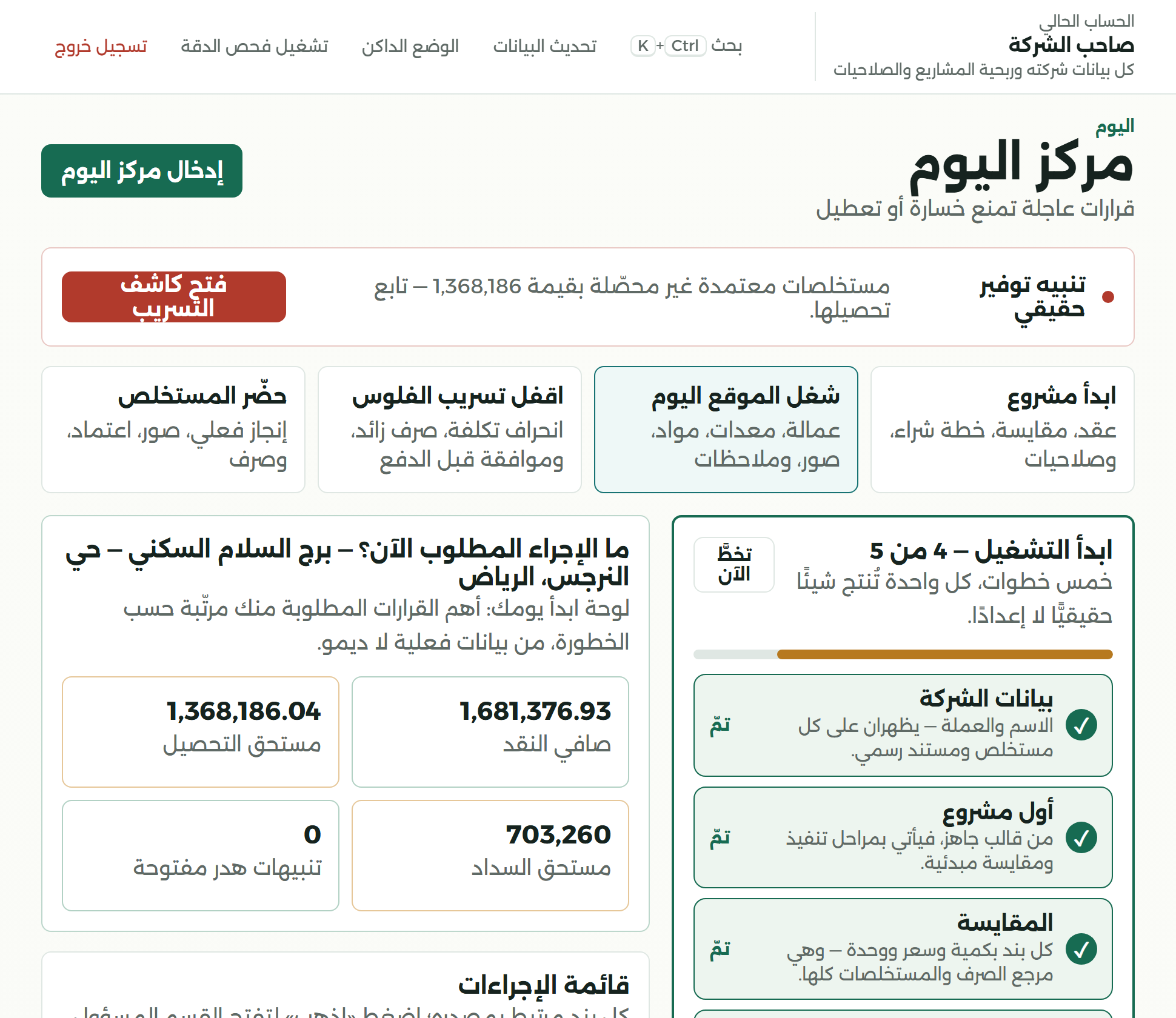
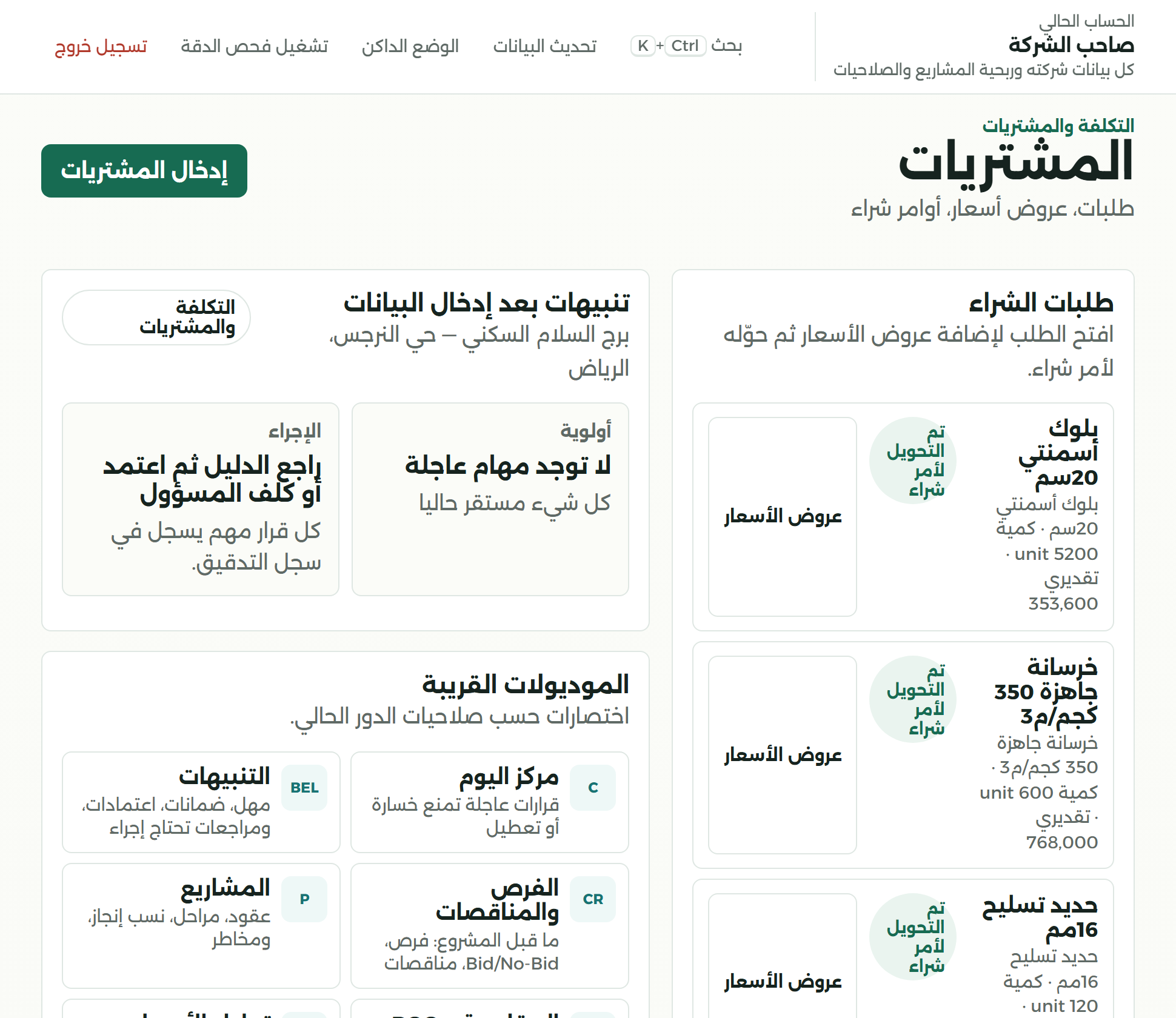
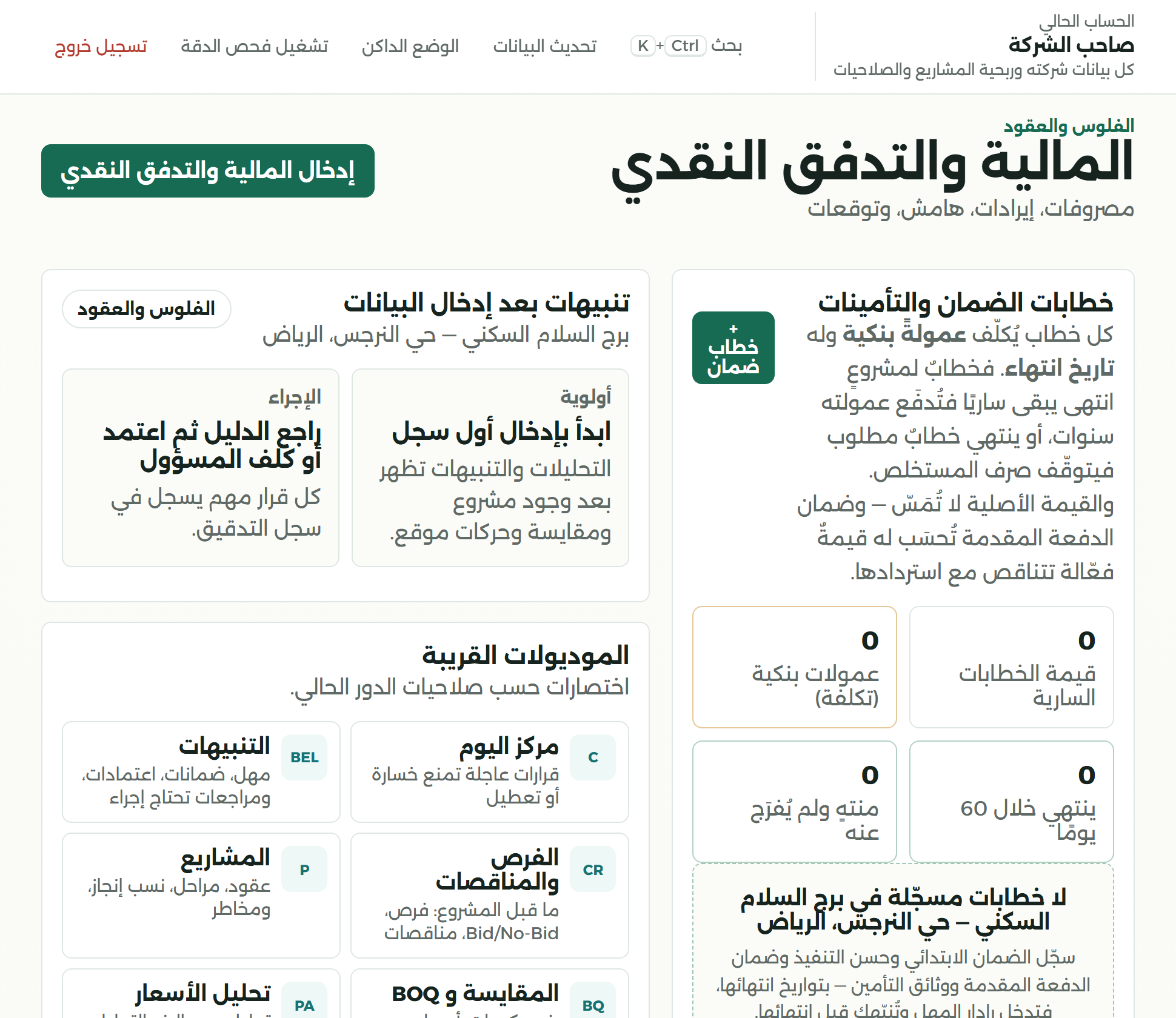
Three screens from a running build, carrying one coherent project: a 24-apartment residential building, an 11-million contract, a 15-line bill of quantities. The interface is Arabic and right-to-left, as it ships.
What it does — not what it promises
Every item here is implemented in the code and covered by a test, and every number is taken from the source rather than from a brochure.
12 waste-detection rules
They compare plan against actual: issue beyond quantity, commitment beyond budget, work done but never billed, consumption deviation, price inflation, a variation with no cover, idle equipment, labour with no output. Each finding carries its own evidence.
A certificate cannot exceed the BOQ
Cumulative certified quantity is checked against the planned quantity in the bill of quantities, and anything beyond it is rejected — not accepted behind a warning that gets dismissed.
Retention that is never forgotten
Calculated from the certificate ledger rather than typed by hand, and released in two stages on dates that come from the closeout register. A rejected certificate retains nothing.
An advance that recovers itself
Deducted from every owner certificate at the agreed rate, and the total recovered never exceeds what was paid out. A number that is calculated, not remembered.
Guarantees on the deadline radar
Every guarantee carries a mandatory expiry date and a calculated commission — so the one left live on a finished project surfaces before it charges another year.
An audit log that cannot be edited
Each entry hashes the hash of the one before it, so editing or deleting a row in the database breaks the chain from that point on — and that shows on screen and in the periodic check.
Permissions live in the server, not in the screen
Four roles: company owner, engineer, site foreman, and platform admin. Hiding a button is not a permission — an engineer who posts a project creation request from outside the UI gets a 403 from the server, and that is tested role by role. An engineer sees only the projects assigned to them, not the whole company's.
It works where you work
Site, with no signal
The daily report and its photos are recorded while the connection is down and sent when it returns — a foreman should not have to find a cell tower to log the day.
Phone first for the field
The foreman's screen is today's tasks, not a system tree: one tap opens the thing they came to do.
Tenant isolation, tested
Each company's data is scoped by its own id in every query, and it is tested that one company cannot read a single row of another's.
What is not there yet — said here, not discovered after buying
The application's interface is in Arabic today. The English layer is built and working but not yet complete, and the switch stays hidden until it is — a button that hands you a left-to-right layout full of Arabic text is worse than no button. This website is in both.
No online payment yet — contracting is by direct contact. See Pricing.
And we do not claim artificial intelligence. The waste detector is deterministic rules reading your own data and showing their evidence — no language model, no prediction. A deterministic rule can be reviewed and explained; a model is believed or doubted, and cannot be argued in a meeting.